 Policing.uk
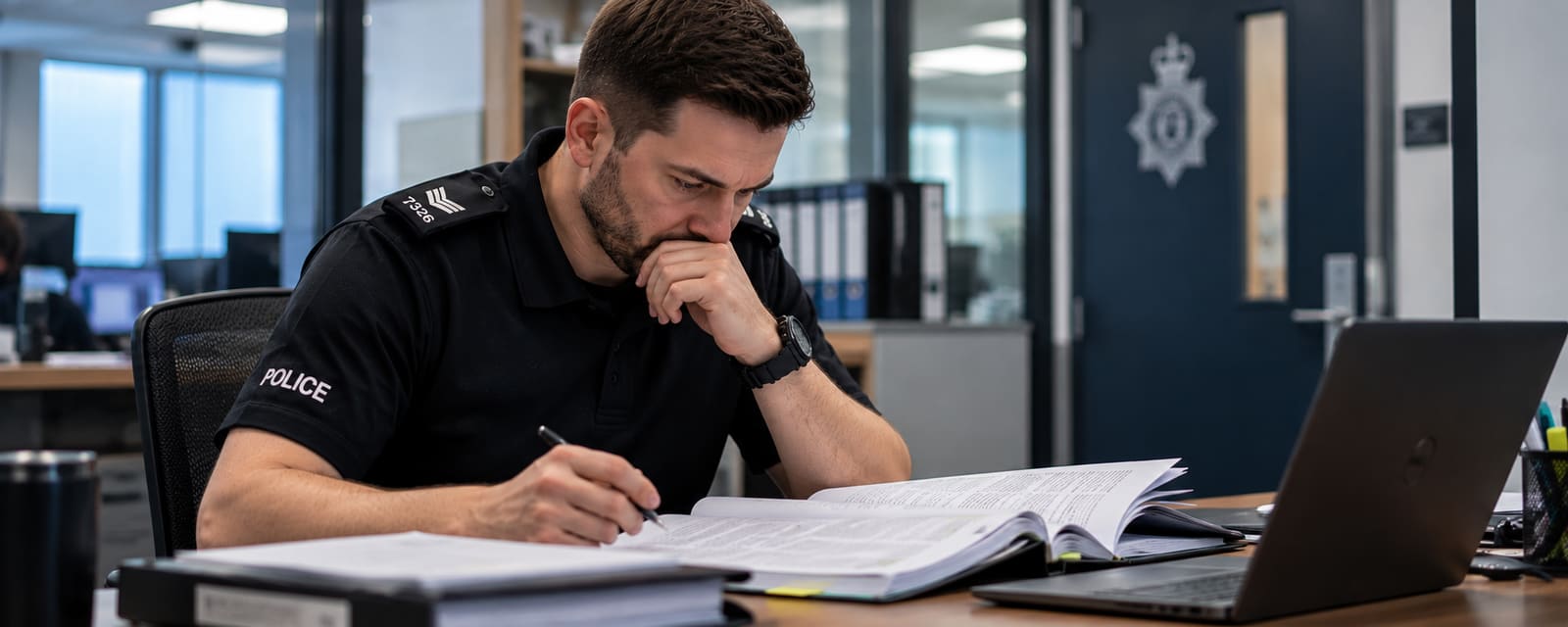
Conducting police searches
Unit 6 of the Level 5 Diploma, on searching premises, vehicles and outside spaces, with the law behind it and the pages on this site to read alongside.
What the unit covers
Conducting police searches is unit 6 of the SFJ Awards Level 5 Diploma in Professional Policing Practice, at 98 guided learning hours and 18 credits. Despite the short title it is the premises unit: the handbook's purpose statement covers searches "across various settings, including premises, vehicles, and outdoor areas", and searches of people are a separate unit.
The first learning outcome is to understand the powers and how to establish grounds and authority: the legal and statutory requirements for searching vehicles, premises and open spaces, including establishing authority before a search, the difference between reasonable suspicion and belief, and when the threshold changes, together with the effect of searches on procedural justice. The second is practical and long: communicating with those at the search scene, identifying the correct search areas, establishing grounds for a lawful search or entry, identifying health and safety risks, protecting the scene, preventing loss or contamination of evidence, using approved search techniques, judging the significance of items found, seizing items the power covers, keeping seized items intact, leaving the scene in the required condition, documenting every decision and rationale, and acting professionally and ethically.
The assessment guidance requires at least one example from each of the three search types: vehicle, premises and outside space. The apprenticeship standard (ST0304) has the same scope as duty 7, conducting safe, lawful and effective searches of premises, vehicles and outside spaces.
The law and procedure behind it
This summary follows the site's own pages linked under Read on this site, which carry the section and Code citations; the sources listed above are the training documents, not the Acts. Read the Act or Code before relying on any point here.
A home has the protection of Article 8 of the European Convention, so police may enter only with the occupier's consent or under a specific statutory power; entry without either is trespass and the evidence may be excluded. Three PACE sections carry most entries. Section 17 allows entry without a warrant to arrest for an indictable offence or certain listed offences, to recapture a person unlawfully at large, to save life or limb, or to prevent serious damage to property. Section 18 allows a search of premises occupied or controlled by a person under arrest for an indictable offence, for evidence of that or a connected offence, normally on an inspector's written authority and exceptionally before the person reaches the station. Section 32 allows a search of the premises where the person was at or immediately before arrest. The common law power to enter to prevent a breach of the peace survives alongside them.
Where none of those applies, a warrant is needed. Section 8 lets a magistrate issue one where there are reasonable grounds to believe an indictable offence has been committed and material of substantial value is on the premises; sections 15 and 16 require sworn written information, specify what the warrant must state, and require the officer to identify themselves, produce the warrant and leave a copy. Other statutes have their own warrants, among them section 23(3) of the Misuse of Drugs Act 1971, section 26 of the Theft Act 1968 and section 46 of the Firearms Act 1968. Journalistic and confidential material needs a circuit judge under Schedule 1. Code B governs every premises search, requiring a written record and minimum inconvenience to the occupant, and it applies equally to a search by consent.
Seizure and vehicles follow. Section 19 lets a constable lawfully on any premises seize anything reasonably believed to be evidence of an offence where seizure is needed to stop it being concealed, lost or destroyed, and section 22 allows retention for as long as the purpose requires. Stopping a vehicle under section 163 of the Road Traffic Act 1988 confers no power to search it; section 1 of PACE, or section 23 of the Misuse of Drugs Act 1971, must be identified before the vehicle is searched.
Read on this site
Powers
- Warrant to Enter and Search Premises
- Safeguards for Search Warrants
- Entry to Premises to Arrest or Recapture
- Entry to Save Life or Limb
- Entry and Search of Premises After Arrest
- Urgent Entry After Arrest Without Inspector Authorisation
- Search Upon Arrest
- General Power of Seizure on Lawful Premises
- Retention of Seized Property
- Access to Special Procedure and Excluded Material
- Warrant to Enter and Search Premises for Controlled Drugs
- Vehicle Search for Controlled Drugs
- Search Warrant for Stolen Goods
- Entry and Search of Premises for Firearms
- Entry to Prevent Breach of the Peace
PACE
Rights
- Your Rights During a Police Search of Your Home
- What Are My Rights During a Police Dawn Raid?
- Can Police Enter My House?
- Can Police Search My Car?
- Can Police Take My Property?
Glossary
Knowledge
- Police Powers of Entry Explained
- Key Cases on Police Entry and Search
- Powers to Stop and Search Vehicles
- Police at Your Door: What Are Your Rights?
Compare
Legislation
Where it sits in training
The College of Policing's 2026 joining guide sets the shared milestones: initial off-the-job learning within five to six months, tutored patrol within ten months, and full operational competence at around two years, with an evidence portfolio built throughout. Premises and vehicle searches are routine on tutored patrol, which is where the three required examples are usually gathered.
In the diploma, the practical criteria are assessed once Independent Patrol Status is confirmed, each on at least two occasions in the Operational Competence Portfolio, and the handbook maps them to the national Independent Patrol Status criteria. The knowledge on grounds, authority and procedural justice is evidenced at least once and sits in the off-the-job phase.
Sources
Last updated 19 October 2026. Reviewed 19 October 2026