 Policing.uk
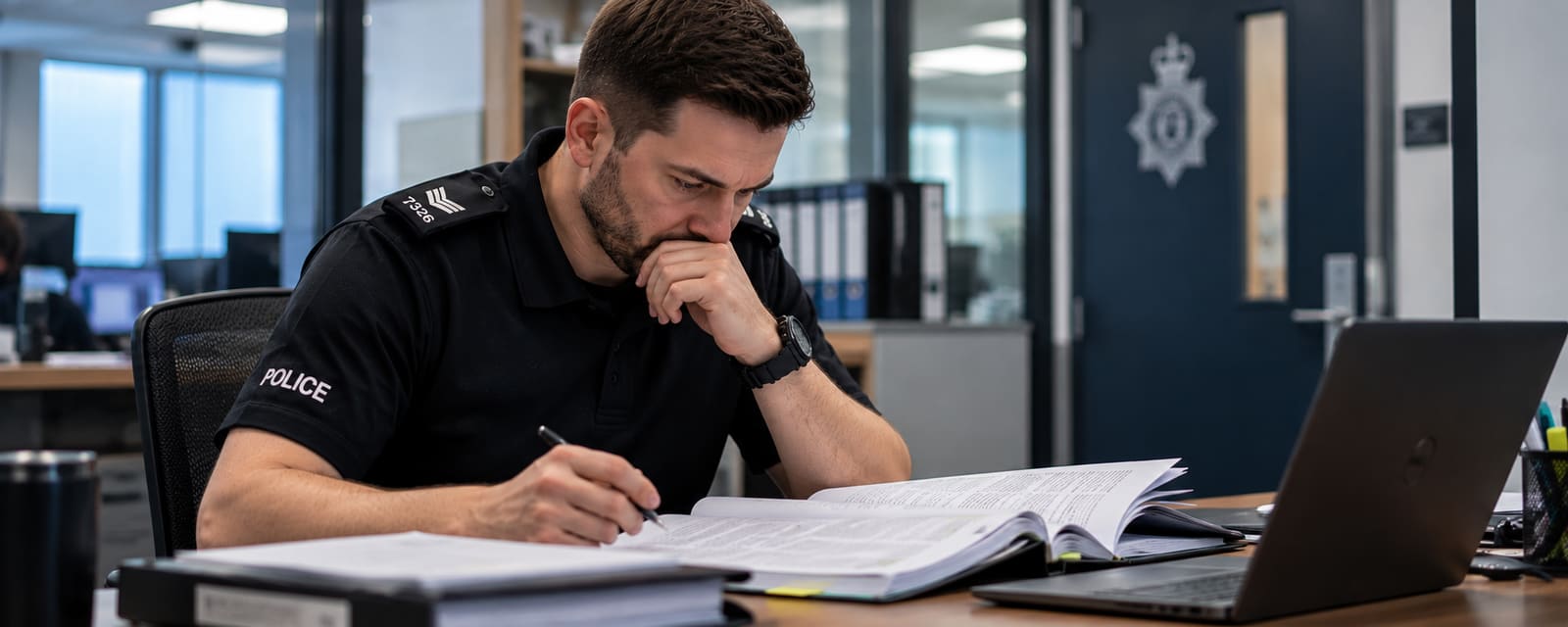
Conducting priority and volume investigations
Unit 8 of the Level 5 Diploma in Professional Policing Practice, with the law behind it and the pages on this site to read alongside.
What the unit covers
Conducting priority and volume investigations is unit 8 of the SFJ Awards Level 5 Diploma in Professional Policing Practice, at 180 guided learning hours and 34 credits, one of the three largest units. The handbook says it covers the foundational concepts of investigative work and how to carry investigations out in accordance with legal and organisational requirements.
The first learning outcome is to understand the principles: the ethical considerations, what is meant by an investigative mindset, and why an investigation should be suspect focused. The second is to understand how an investigation is conducted: its stages, the strategies for gathering evidence at home and abroad, the effect of technology, the overlap between types of investigation, how to run an evidence-led investigation where the victim is reluctant or withdraws, the additional actions a more complex case demands, and the process for providing material to the Crown Prosecution Service for disclosure. The third is practical and runs to sixteen criteria: planning, gathering information and evidence, building case files and managing exhibits, briefing others, escalating, identifying victims, witnesses and suspects, dealing with suspects, supporting victims and their families, evaluating throughout, handling more complex interviews, internet-facilitated crime, managing cases through the criminal justice process, recording with disclosure in mind, evaluating for future learning, and acting ethically.
The assessment guidance requires evidence from complex investigations as well as routine ones. In the apprenticeship standard (ST0304) the ground is duty 9, conducting priority and volume investigations, with duty 14 for more complex ones, and volume and priority investigator is a typical job title.
The law and procedure behind it
This summary follows the site's own pages linked under Read on this site, which carry the section and Code citations; the sources listed above are the training documents, not the Acts. Read the Act or Code before relying on any point here.
Investigation is governed by the College of Policing's APP, PACE 1984 and its Codes, and the Criminal Procedure and Investigations Act 1996. The early stage turns on the golden hour: securing the scene, separating witnesses, starting house-to-house enquiries and identifying CCTV and digital sources while evidence is freshest. Physical evidence is collected to forensic protocols with a chain of custody from seizure to court, each item labelled, bagged and logged. Where a witness has or could identify a suspect, Code D requires an identification procedure before charge, usually a video identification in which the suspect appears alongside at least eight others of similar appearance.
The classification of the offence shapes the powers available. Summary offences are tried in the magistrates' court and police may charge them without CPS authority; either-way and indictable offences unlock powers such as the section 18 search and extended detention, and their charging decisions go to the Crown Prosecution Service under the Director's Guidance. The CPS applies the Full Code Test: an evidential stage asking whether there is a realistic prospect of conviction, then a public interest stage. A decision to take no further action closes the case against that person without preventing it being reopened on new evidence. A suspect released before a decision is on pre-charge bail, with time limits, or released under investigation.
Disclosure runs through the whole process. The 1996 Act sets the duties of investigator, prosecutor and defence over unused material, and the prosecution must disclose anything capable of undermining its case or assisting the defence; failures have caused miscarriages of justice, and public interest immunity to withhold material is the exception, scrutinised by the court. Section 78 of PACE lets a court exclude evidence whose admission would make the proceedings unfair, which is the sanction behind every procedural rule above. The offence pages on this site give the maximum sentence and mode of trial for the volume crimes a response officer investigates most.
Read on this site
Powers
- General Power of Seizure on Lawful Premises
- Entry and Search of Premises After Arrest
- Warrant to Enter and Search Premises
- Taking Fingerprints
- Taking Non-Intimate Samples
Offences
- Theft
- Theft from a Shop
- Burglary of a Dwelling
- Criminal Damage
- Common Assault
- Actual Bodily Harm
- Harassment / Stalking
- Fraud by False Representation
- Taking a Vehicle without Consent
- Handling Stolen Goods
- Going Equipped for Theft or Burglary
- Possession of Class B Drug
PACE
Rights
- What Rights Do I Have as a Victim of Crime?
- What Are My Rights as a Witness?
- What Are My Rights If Wrongly Accused?
Glossary
- Golden hour
- Crime scene
- Scene preservation
- Forensic evidence
- Body-worn video
- Identification procedure
- Disclosure
- Section 78 PACE exclusion
- NFA
- Charge
- Summary offence
- Either-way offence
- Indictable offence
- Released under investigation (RUI)
Knowledge
- How Police Investigate Crime
- Evidence Gathering by Police
- CPS Charging Decisions: The Full Code Test
- Identification Procedures Under PACE Code D
- Key Cases on Disclosure and Evidence
- Police Bail: Pre-Charge and Post-Charge
- PACE 1984: An Overview
Compare
- Summary offence vs indictable offence
- Custody sergeant vs investigating officer
- Police bail vs released under investigation
Legislation
- Criminal Procedure and Investigations Act 1996
- Prosecution of Offences Act 1985
- Criminal Procedure Rules 2020
Aide-memoires
Where it sits in training
The College of Policing's 2026 joining guide sets the shared milestones: initial off-the-job learning within five to six months, tutored patrol within ten months, and full operational competence at around two years, when the recruit is signed off as fully competent in operational duties. Investigation is one of the five specialist areas a PCDA or DHEP recruit may take in the final year, and the guide notes that detective pathways add further content and a two-year probation.
This unit straddles both national standards. The handbook maps most of its practical criteria to the Independent Patrol Status criteria, but the criteria on more complex interviews, internet-facilitated crime and managing a case through the criminal justice process are mapped to Full Operational Competence, so they are the last evidence a recruit gathers before sign-off at around the two-year point. As with every unit, performance criteria are assessed only after Independent Patrol Status and evidenced at least twice.
Sources
Last updated 19 October 2026. Reviewed 19 October 2026