 Policing.uk
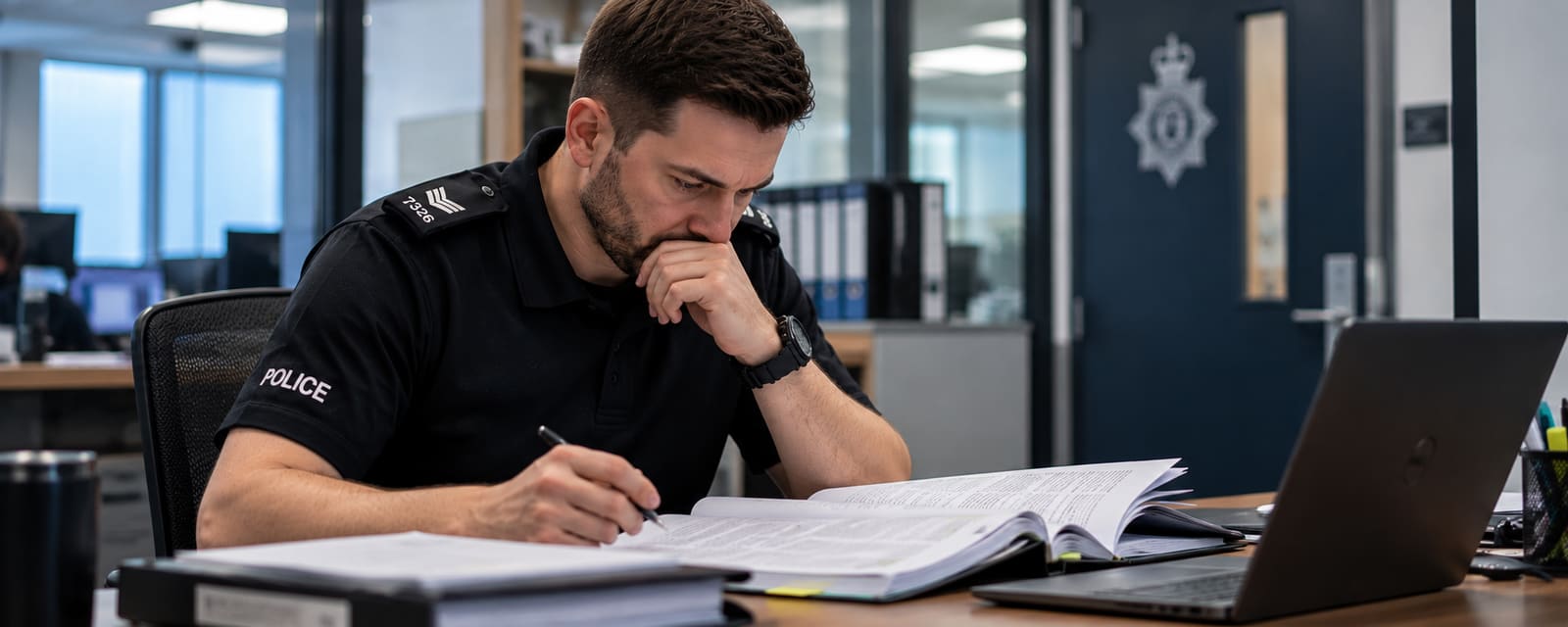
The golden hour
The period straight after a report when material can still be secured, as the College of Policing defines it and the CPIA Code requires it to be kept.
The expansion
The golden hour is a phrase, not an acronym. What recruits are taught to do inside it comes from the College of Policing's Investigation process guidance, which says each officer or member of staff responding to a crime or incident must help to:
- preserve life and secure material
- minimise the amount of material that could be lost to the investigation
- maximise the chance of securing material that will be admissible in court
What it is for
The College's guidance (December 2022 PDF and the online page updated 8 October 2026, both read 19 October 2026) defines the term: "The golden hour is the period immediately following the report of an offence or incident, where positive action should be taken. This may include protecting, preserving or gathering material that may otherwise have been concealed, lost, damaged, altered or destroyed."
It is not a literal sixty minutes. Every member of police personnel has "their own golden hour opportunities specific to their role", and the principle also applies to "the discovery of any new scene, arrest of suspect or other key activity that has a time-critical implication", CCTV being the example given.
Where it comes from
The phrase is the College's. Its guidance sets out golden hour considerations by area. For victims, witnesses and suspects: identification, risk assessment, safeguarding, support such as a family liaison officer, and sensitively preserving an initial account and material such as clothing, forensic samples and digital opportunities. For locations: identifying crime scenes, initial searches of access and exit routes, forensic examination, and CCTV and passive data. The guidance calls these fast-track actions and says the list is not exhaustive.
The legal duty behind it is in the Criminal Procedure and Investigations Act 1996 Code of Practice (Crown copyright, in force 31 December 2020). Paragraph 5.1: "The investigator must retain material obtained in a criminal investigation which may be relevant to the investigation." Paragraph 4.4 requires relevant information to be recorded "at the time it is obtained or as soon as practicable" afterwards. Material lost in the first hours cannot be retained later.
When it is used
By the first officer at any scene, by the officer making an arrest, and by anyone who finds a new scene or a time-limited source such as CCTV. The powers to secure a scene and to search on arrest are on their own pages below.
This page is educational information about how officers are trained.
Read on this site
Sources
Last updated 19 October 2026. Reviewed 19 October 2026