 Policing.uk
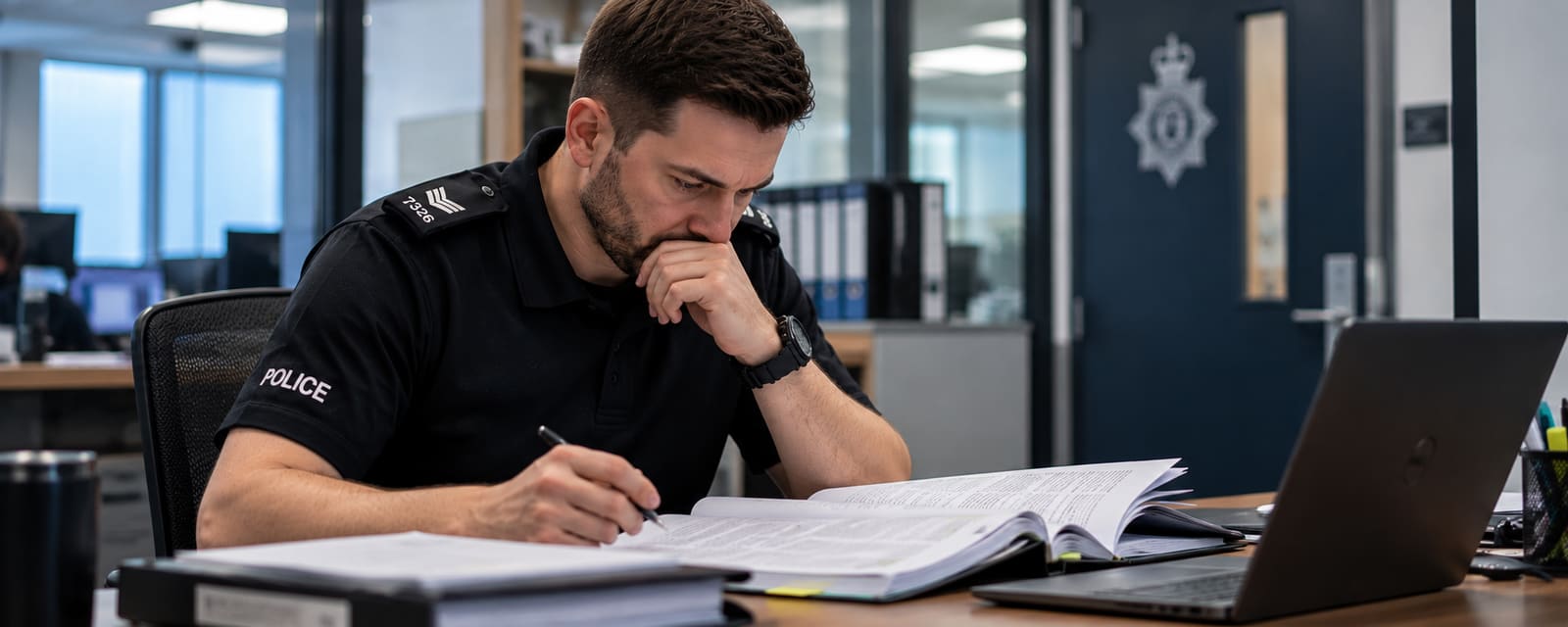
Providing an initial response to policing incidents
Unit 2 of the Level 5 Diploma in Professional Policing Practice, with the law behind it and the pages on this site to read alongside.
What the unit covers
Providing an initial response to policing incidents is unit 2 of the SFJ Awards Level 5 Diploma in Professional Policing Practice. At 180 guided learning hours and 34 credits it is one of the three largest units, matched only by investigations and interviewing.
The handbook sets four learning outcomes. The first is to understand the response policing role: what a first responder is responsible for, the considerations when attending an incident, the post-incident procedures that follow the use of protective equipment or restraints, the additional responsibilities in public order situations, and the police role in critical, major and joint emergency services incidents. The second is to understand the National Decision Model, its elements, and the barriers that can affect decision-making during an incident. The third is practical: to apply policing skills as a first responder, respond to critical incidents, communicate at the scene, support victims and witnesses, use a recognised approach to vulnerability (the handbook gives THRIVE as its example), control the scene and preserve evidence, make multi-agency referrals, record decisions, and use radio protocols. The fourth is to apply the National Decision Model and to compare decisions across a number of incidents.
The indicative content runs through public order, domestic abuse, hate crime, firearms, mental health, road collisions, missing persons, sudden death and terrorism. The handbook's assessment guidance notes that the critical incident criterion can be met by an incident with the potential to become critical, since not every officer attends a confirmed one in training. In the apprenticeship standard (ST0304) the same ground is duty 3, providing an initial response to incidents, and duty 11, the initial response to a critical incident.
The law and procedure behind it
This summary follows the site's own pages linked under Read on this site, which carry the section and Code citations; the sources listed above are the training documents, not the Acts. Read the Act or Code before relying on any point here.
A response usually starts in the control room. The call handler establishes the nature and location of the incident, whether anyone is in danger, and whether the suspect is still present, and the call is graded; most forces use an Immediate grade requiring attendance within 15 minutes where there is a threat to life or a crime in progress, with Priority and Scheduled grades below it. The officer attending then works through the National Decision Model: gather information, assess threat and risk, consider powers and policy, identify options, take action and review, with the Code of Ethics at its centre.
Securing the scene is the first priority on arrival. A common approach path is established to limit contamination and the scene is kept as close to its original state as possible until forensic examination. The first hour after an offence is reported, the golden hour, is when evidence is freshest and witnesses most likely to be present. Entry to premises without a warrant is available under section 17 of PACE to save life or limb or prevent serious injury, and at common law to prevent a breach of the peace, which involves actual or threatened violence to persons or property.
Several incident types carry their own procedure. Section 136 of the Mental Health Act 1983 allows a constable to remove a person who appears to be suffering from mental disorder and in immediate need of care or control to a place of safety; since the Policing and Crime Act 2017 police custody is prohibited as a place of safety for anyone under 18 and restricted for adults. Domestic abuse attendance uses the DASH risk assessment, a 27-question checklist. Missing persons are graded absent, missing or high-risk under the College of Policing's APP. On the roads, section 163 of the Road Traffic Act 1988 lets a constable in uniform stop any vehicle without grounds.
Read on this site
Powers
- Entry to Save Life or Limb
- Entry to Prevent Breach of the Peace
- Removal from Public Place to Place of Safety
- Constable Power to Stop Vehicles
- Road Checks for Serious Offences
- Preliminary Breath Test
Rights
Glossary
- National Decision Model (NDM)
- Crime scene
- Scene preservation
- Golden hour
- Breach of the peace
- Triage
- Street triage
- Place of safety
- DASH risk assessment
- Police pursuit
- Mutual aid
Knowledge
- What Happens When You Call 999
- The National Decision Model
- Section 136: The Mental Health Place of Safety Power
- Police Response to Domestic Abuse
- Missing Persons: How Police Respond
- What Happens at a Traffic Stop
- Key Cases on Police Entry and Search
Compare
Aide-memoires
Where it sits in training
The College of Policing's 2026 joining guide puts the initial off-the-job learning phase within the first five to six months, the tutored patrol phase within ten months, and full operational competence at around two years. It describes every route as operational: recruits go on patrol in their community as soon as practical, supported by experienced officers, and join a shift pattern of days, nights and weekends. Response is one of the five specialist areas a PCDA or DHEP recruit may take in the final year, and response officer is one of the typical job titles in the apprenticeship standard.
Within the diploma, the knowledge in this unit is learned early and the performance criteria are assessed only after the learner has reached Independent Patrol Status, through evidence in the Operational Competence Portfolio. The handbook maps the unit's practical criteria to the national Independent Patrol Status criteria, so a recruit's first months of tutored patrol are where most of this evidence is gathered.
Sources
Last updated 19 October 2026. Reviewed 19 October 2026