 Policing.uk
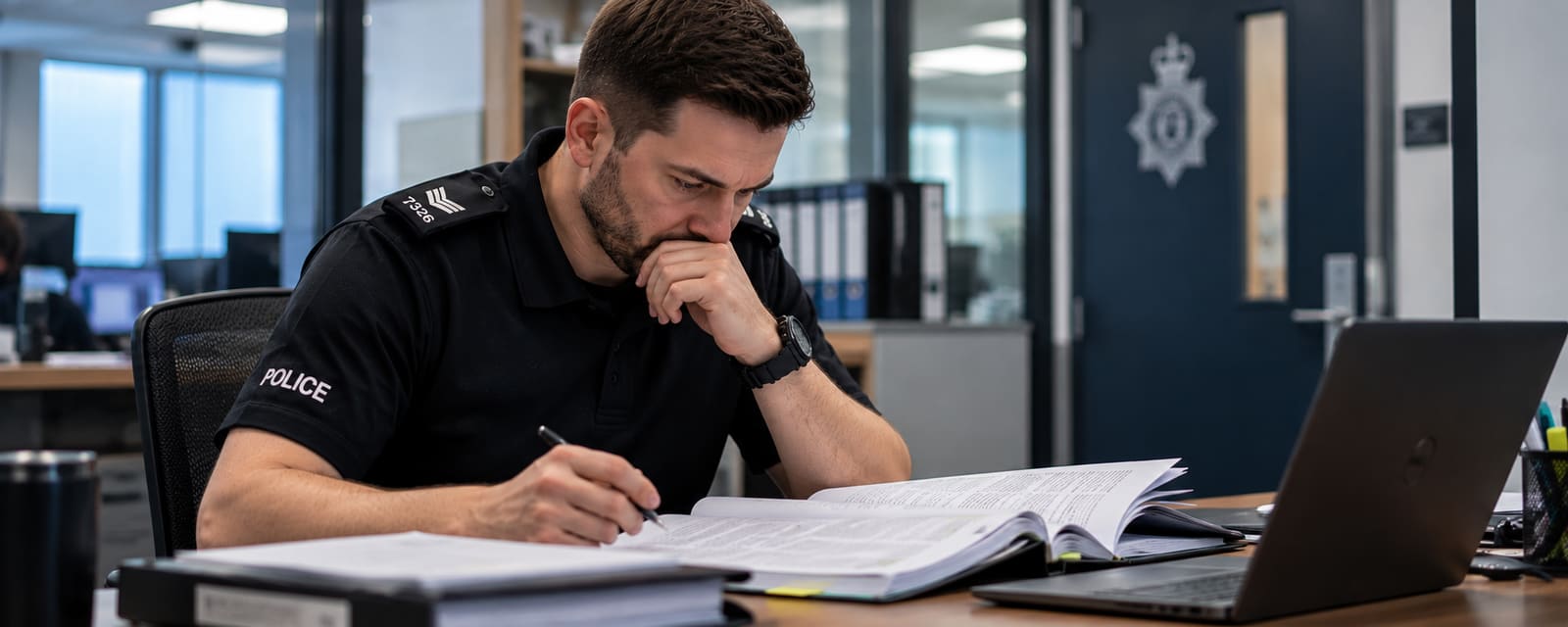
Conducting police searches of individuals
Unit 7 of the Level 5 Diploma in Professional Policing Practice, with the law behind it and the pages on this site to read alongside.
What the unit covers
Conducting police searches of individuals is unit 7 of the SFJ Awards Level 5 Diploma in Professional Policing Practice, at 98 guided learning hours and 18 credits. The handbook's purpose statement names the two powers it has in mind, section 1 of the Police and Criminal Evidence Act 1984 and section 23 of the Misuse of Drugs Act 1971, and sets the standard of compliance with legal and organisational requirements.
There are three learning outcomes. The first is to understand the powers and how grounds and authority are established, starting with the terms involved and the difference between stop and search and stop and account, and covering the use of a search where a power exists and the position where no stop and search power exists. The second is to understand the processes around a search: its potential impact on individuals and the community, including bias and vulnerability; the information that must be given before a search; when the threshold changes on reasonable grounds; the limits of a search; dealing with a young person or a vulnerable person; and the transport, storage and disposal of exhibits. The third is practical: systematic search methods, communicating before and during the search, controlling the person to prevent loss of evidence, escape or harm, personal safety, seizing and preserving items, telling the person the result and what happens next, documenting decisions and rationales, and acting ethically.
In the apprenticeship standard (ST0304) this is duty 8, conducting police searches of individuals in line with legal and organisational requirements.
The law and procedure behind it
This summary follows the site's own pages linked under Read on this site, which carry the section and Code citations; the sources listed above are the training documents, not the Acts. Read the Act or Code before relying on any point here.
There is no general power to search a person on suspicion of criminal activity; every search needs a specific statutory power whose conditions are met. Section 1 of PACE allows a constable to search a person or vehicle in a public place on reasonable grounds to suspect that stolen or prohibited articles will be found, prohibited articles including offensive weapons, bladed articles and items for use in burglary, theft, taking a vehicle or fraud. Reasonable grounds is an objective test: Code A paragraph 2.2 requires a genuine suspicion with an objective basis in facts, information or intelligence, such that a reasonable person would reach the same conclusion, and the paragraphs that follow it rule out appearance, age, race or previous convictions as grounds on their own. Section 23(2) of the Misuse of Drugs Act 1971 gives a parallel power to search for controlled drugs, section 47 of the Firearms Act 1968 for firearms, and section 43 of the Terrorism Act 2000 for evidence that a person is a terrorist.
Code A governs how the search is done. Before it starts the officer must give the information remembered as GOWISELY: grounds, object, warrant card if not in uniform, identity, station, entitlement to a copy of the record, legal power, and that the person is detained for the search. In public no more than an outer coat, jacket and gloves may be removed; anything further must be out of public view by an officer of the same sex. A record must be made and a copy offered. Force during a search must be reasonable and proportionate, and Code A paragraph 1.5 says a person must not be searched, even with consent, where no statutory power applies. Stop and account is different: a voluntary conversation with no power to detain and no statutory record.
Suspicion-free powers are the exception. Under section 60 of the Criminal Justice and Public Order Act 1994 an inspector who reasonably believes serious violence may occur in a locality can authorise searches there for weapons without individual grounds, initially for 24 hours. Section 47A of the Terrorism Act 2000 is the equivalent for terrorism. After arrest the picture changes again: section 32 permits a search for anything that could aid escape or cause injury, the custody officer searches the detainee at the station under section 54, a strip search at the station is governed by Code C Annex A, and an intimate search needs an inspector under section 55. Children face the same threshold as adults but extra safeguards in the manner of the search.
Read on this site
Powers
- Stop and Search for Stolen or Prohibited Articles
- Authorised Stop and Search Without Suspicion
- Personal Search for Controlled Drugs
- Stop and Search for Firearms
- Stop and Search of Persons for Terrorism
- Authorised Stop and Search Without Suspicion (Terrorism)
- Search for Weapons on School Premises
- Search Upon Arrest
- Search of Detained Persons at Police Station
- Intimate Search of Detained Persons
PACE
Rights
- Your Rights During a Stop and Search
- Can Police Search a Minor in the UK?
- Can Police Search Your Bag?
- Can Police Stop You for No Reason in the UK?
- What Are Your Rights When Stopped by Police?
Glossary
- Stop and search
- Stop and account
- GOWISELY
- Reasonable grounds
- Section 1 PACE search
- Section 60 authorisation
- Consent search
- Section 32 search on arrest
- Strip search
- Intimate search
Knowledge
- GOWISELY Explained
- Stop and Search: The Legal Framework
- Section 60 Stop and Search Powers
- Stop and Search Powers: An Overview
- Key Cases on Stop and Search
Compare
Aide-memoires
Where it sits in training
The College of Policing's 2026 joining guide gives the milestones shared by every route: initial off-the-job learning within five to six months, a tutored patrol phase within ten months, and full operational competence at around two years. Stop and search is among the first powers a recruit exercises on tutored patrol, with a tutor constable present.
In the diploma, the practical criteria are assessed after Independent Patrol Status has been confirmed, each evidenced at least twice in the Operational Competence Portfolio, and the handbook maps them to the national Independent Patrol Status criteria. The knowledge criteria on grounds, impact and the pre-search information are evidenced at least once and are covered off the job before the first patrol.
Sources
- www.gov.uk/government/publications/pace-code-a-2023/pace-code-a-2023-accessible
- sfjawards.com/app/uploads/2024/10/L5-Dip.-in-Professional-Policing-Practice-Handbook.pdf
- skillsengland.education.gov.uk/media/4eihz5i1/st0304-police-constable-l6-standard.pdf
- assets.college.police.uk/s3fs-public/2026-04/Guide-to-joining-the-police-service-ebook.pdf
Last updated 19 October 2026. Reviewed 19 October 2026