 Policing.uk
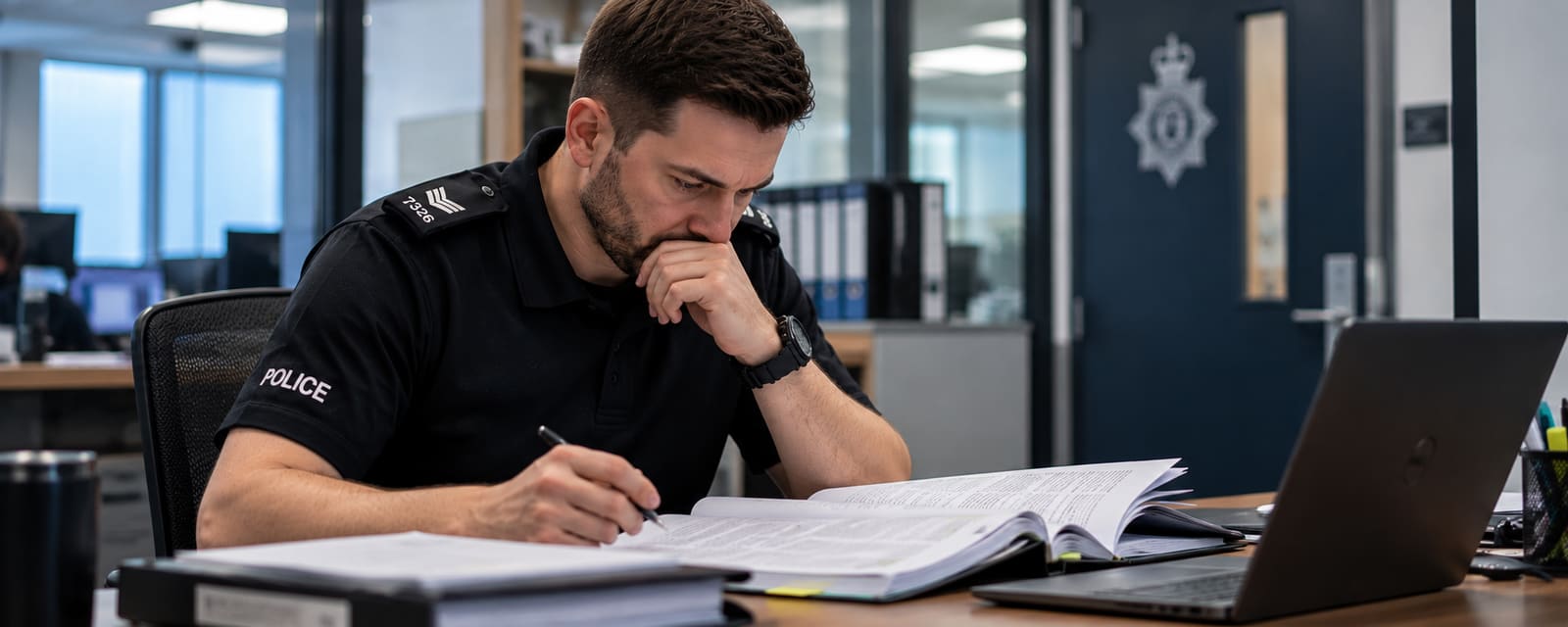
The sergeants' and inspectors' exam
The NPPF step two legal examination in 2026, with its format, syllabus, pass marks, sitting dates and the pass rates the College has published.
Promotion to sergeant and to inspector in England and Wales runs through the National Police Promotion Framework (NPPF). The College of Policing's candidate handbook for 2026 sets out four steps: competence in the current rank, a legal knowledge examination, assessment against rank-specific competencies with matching to a vacancy, and a period of temporary promotion with work-based assessment. This page covers the second step, the legal examination, as the handbook describes it. It is educational information for officers planning their study.
The paper
The sergeants' and inspectors' examinations share one shape. Each is a single paper of 150 multiple-choice questions taken online in three hours. The paper must be completed in one sitting; a candidate may take a comfort break, but the timer does not stop. Each exam runs over three days, and a candidate sits on one of those days within a 12-hour window.
Not all 150 questions count. At the marking stage the marking panel removes the ten questions that performed least well, and every candidate is scored on the remaining 140. Candidates are not told which questions were removed and cannot appeal the removal.
The questions are written by trained question writers who have attended the College's question-writing course, and are checked for legal accuracy by the College's legal services unit and by independent legal experts.
There is no national limit on resits; any limit is a force decision. A step two pass has a five-year life: the handbook's table shows, for example, that a candidate who passed the sergeants' exam of 18 to 20 March 2025 must reach step three by 19 March 2030.
What it covers
The questions test three areas: crime, evidence and procedure, and general police duties. The syllabus is the 2026 edition of the Blackstone's Police Manuals, in three volumes matching those areas, and the handbook states that these are the only resource the College endorses. "Examination questions are drawn solely from the contents of these manuals." Candidates are warned not to rely on earlier editions. Appendix A of the handbook lists the examinable chapters of each volume for each rank, since some rank-specific areas differ between sergeants and inspectors.
The balance of questions follows a blueprint built from a nationwide survey of serving sergeants and inspectors, weighted towards the law those officers meet most often, but any part of the syllabus can be asked. The exam is not meant to test recall of the manuals' tables. Where the text refers to a paragraph of a Code of Practice under the Police and Criminal Evidence Act 1984, candidates are expected to know that provision.
Pass marks
The pass mark is 55 per cent for sergeants, which is 77 correct answers out of 140, and 65 per cent for inspectors, which is 91 out of 140. An exceptional grade goes to candidates scoring 75 per cent or more in the sergeants' exam and 85 per cent or more in the inspectors'. A low-band fail is recorded below 30 per cent for sergeants and below 35 per cent for inspectors. The debrief panel reserves the right to alter the pass mark in exceptional circumstances.
2026 dates
The handbook gives two sittings for each rank:
- Sergeants: Tuesday 17 to Thursday 19 March 2026, and Tuesday 6 to Thursday 8 October 2026.
- Inspectors: Tuesday 12 to Thursday 14 May 2026, and Tuesday 3 to Thursday 5 November 2026.
Registration closes at 6pm on 19 February 2026 for the March sergeants' exam, 16 April for the May inspectors', 10 September for the October sergeants' and 5 October for the November inspectors'. Those are the College's final dates; forces may set earlier ones. Results are due by 9 April, 4 June, 29 October and 26 November 2026 respectively, as a feedback report accessed through AIMS, which also serves as proof of the result.
Eligibility for the sergeants' exam is limited to regular constables who, by the exam date, have completed two years' service and their probation and have not already passed a recognised promotion exam. All candidates must also meet the step one criteria, including a competence record in their PDR and no live performance or conduct warnings.
Pass rates
The College publishes a results and analysis overview after each sitting. The four most recent that could be read on 19 October 2026 give these figures:
- Sergeants, March 2026: 3,215 candidates attended and 1,882 passed, a success rate of 58.5 per cent, at a cut score of 55 per cent.
- Sergeants, March 2025: 3,507 candidates attended and 1,967 passed, a success rate of 56.1 per cent, at a cut score of 55 per cent. Female candidates passed at 61.1 per cent and male candidates at 53.8 per cent. The Metropolitan Police Service entered 1,357 candidates, of whom 488 passed (36.0 per cent).
- Inspectors, May 2025: 1,682 attended and 581 passed, 34.5 per cent, at a cut score of 65 per cent. Female candidates passed at 37.4 per cent and male candidates at 33.4 per cent. The Metropolitan Police Service entered 538 and 117 passed (21.7 per cent).
- Inspectors, November 2025: 1,693 attended and 413 passed, 24.4 per cent, at a cut score of 65 per cent. Female candidates passed at 24.0 per cent and male candidates at 24.5 per cent. The Metropolitan Police Service entered 518 and 73 passed (14.1 per cent).
Each report redacts small force numbers and warns that force comparisons should be made with caution because entry numbers differ so widely. No sergeants' report for October 2025 or October 2026 was read for this page.
How people prepare
The handbook is direct about the reading list. The 2026 Blackstone's Police Manuals are the syllabus text, and the College endorses nothing else for the exam; it notes that other products, including the Blackstone's Q&As, are not affiliated with the College. For practice material the handbook points to one place: the Candidate Online Examination Guidance group on the College's Knowledge Hub, which holds practice questions, exam tips, and a learning style and revision technique guide for candidates to download. Access is arranged through the force examinations officer, who is also the first point of contact for any question about the exam.
What is changing
The College has been testing a replacement for the NPPF, the Sergeant and Inspector Promotion and Progression process, in a small number of forces. It keeps a legal knowledge exam but changes its length and the stages around it. Forces outside the test continue with the NPPF exam described here. The status of the test, the forces involved and the proposed timetable are on the SIPP page.
Sources
- assets.college.police.uk/s3fs-public/2026-04/NPPF-sergeants-results-and-analysis-overview-March-2026.pdf
- assets.college.police.uk/s3fs-public/2025-09/nppf-candidate-handbook-2026.pdf
- assets.college.police.uk/s3fs-public/2025-04/NPPF-sergeants-results-and-analysis-overview-March-2025.pdf
- assets.college.police.uk/s3fs-public/2025-06/NPPF-inspectors-results-and-analysis-overview-May-2025.pdf
- assets.college.police.uk/s3fs-public/2025-11/NPPF-inspectors-results-and-analysis-overview-Nov-2025.pdf
Last updated 19 October 2026. Reviewed 19 October 2026